Why a Private AI Companion Might Be the Next Viral Social App?
Social media has changed so much in the recent past. Not only have there been more options, but also the modes people interact with. For years, most people relied on broadcasting their lives to a network of acquaintances or scrolling through a feed determined by an algorithm. Unfortunately, these networks feel more corporate and less personal. This has made people look for options to fill the emotional gap. Most reviewers rank the best AI girlfriend apps based on engagement metrics. They focus purely on the romantic novelty and miss a much larger cultural shift.
The real story now is about how private AI companions are redesigning the mechanics of viral social applications from the ground up. Let’s see how.
The Feed Is Full. The User Still Feels Alone
Interestingly, while most social platforms are more crowded than ever, they feel empty. An Institute for Public Policy Research (IPPR) anti- media report showed little interaction between acquaintances on social media.
Major platforms like Instagram, TikTok, and X show twice as much content from strangers, influencers, and sponsored brands as from users’ friends and family. Only about 18% of the posts come from people they actually know. Since these broadcast channels are optimized for sticky engagement, people consume more content but have fewer social exchanges.
AI Companions Turn Social Media Inside Out
Traditional social media uses a one-to-many structure. When you post a thought, video, or photo, it is validated by different groups of people. This approach is different from AI companion apps.
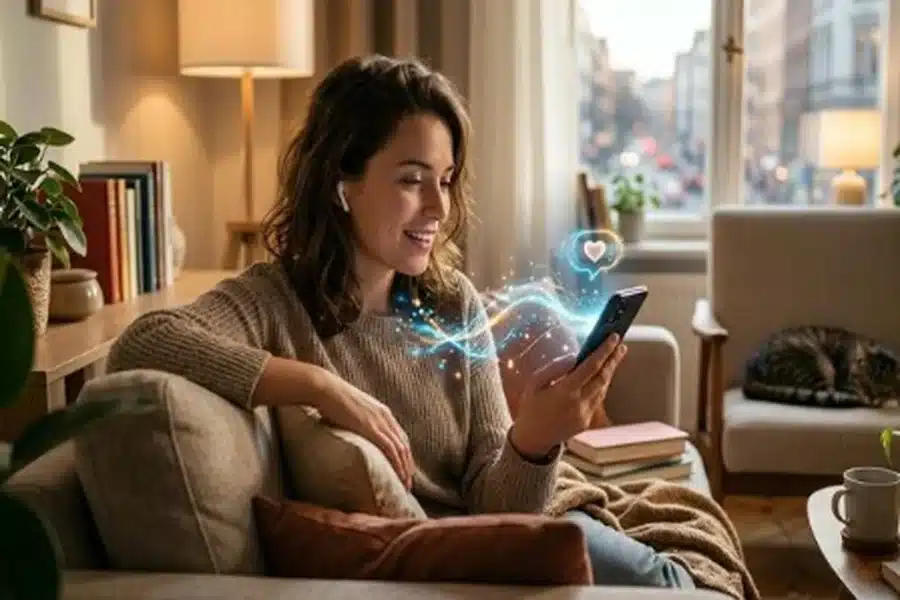
In the apps, you engage in a deep, continuous, one-to-one dialogue with a single responsive entity. Since the interaction is private, you are not pressured to impress, perform, or curate a perfect aesthetic. This way, the companions replace a crowd with a dedicated conversational partner. So, they transform the digital experience from an exhausting public performance into a personal sanctuary.
The Next Social App May Not Need a Public Feed
The general industry feeling is that a viral social app should have a public network effect. This means a central feed for users to discover each other. However, this is not the case anymore. Currently, most internet users are moving from open comment sections to closed group chats, DMs, anonymous spaces, and private channels.
It indicates that most people want to do it behind closed doors. An AI companion app fits the new trend perfectly. It proves that an application can achieve massive user scale without relying on a public town square. The social element is about the intimacy of the interaction itself.
How AI Companion Apps Could Go Viral Without Looking Like Social Media
Can an app spread without having a public feed? Absolutely! The viral secret for private AI is based on shareable cultural artifacts rather than explicit networking. Users love sharing screenshots of bizarre, deeply profound, or hilarious text exchanges. Besides, personality quizzes that generate a custom companion based on your psychological profile naturally invite users to share their results.
Additionally, side-by-side comparisons of different character personalities, customized memes generated within the chat, and the sheer “you have to try this” novelty of an agent that remembers an obscure detail you mentioned three weeks ago. This helps create organic, cross-platform loops. The app spreads publicly precisely because the experience inside it is so intensely private.
The Product Is Not The Chatbot. It’s the Feeling of Being Heard.
The technical core of these applications is a large language model, but the actual consumer product is emotional continuity. What keeps users returning isn’t the underlying code; it’s the profound psychological reward of feeling heard.
A private AI companion builds a historical narrative with the user through persistent memory and adapted tones. For example, if you say you have a stressful work presentation on Tuesday, it remembers and will ask about it on Wednesday. This undivided attention is rare in digital interactions.
The Privacy Problem Behind Private AI Companions
This intense feeling of emotional safety introduces a distinct digital vulnerability. Users naturally overshare deeply personal information if the interface feels non-judgmental and private.
However, recent privacy research published on arXiv found some disconnect. While the emotionally secure environment encourages high levels of self-disclosure, users experience some privacy turbulence. They feel safe in the immediate conversation but remain highly uncertain and powerless regarding platform-level data control. The anthropomorphic design trick of a caring friend often obscures the reality that the companion is run by a corporate entity collecting valuable behavioral data.
Final Thought: The Next Social App Might Be Less Public, Not More Social
The rise of the private AI companion presents a striking paradox for the future of tech. The next blockbuster “social” app might not actually connect you to other human beings at all. Aigirlmates has observed this shift across many leading AI companion platforms, where engagement is increasingly driven by one-on-one interactions rather than traditional social networking.
As human relationships become more complicated by digital noise and algorithmic distance, an optimized, private interface that listens without judgment looks less like a gimmick and more like a structural inevitability. The future of social media may well belong to platforms that are far less public, focusing less on connecting society and more on curing the isolation of the individual.