Five Questions Before You Route Production Traffic
Through OrcaRouter the Qwen3.8 Flash Next abliterated API is a reasonable candidate for production, but “reasonable candidate” is not “ready”, and the gap between the two is five questions. Each is answerable in an afternoon, and each has a cheap version and an expensive version — the cheap version is answering it before you route traffic, and the expensive one is discovering it afterwards.
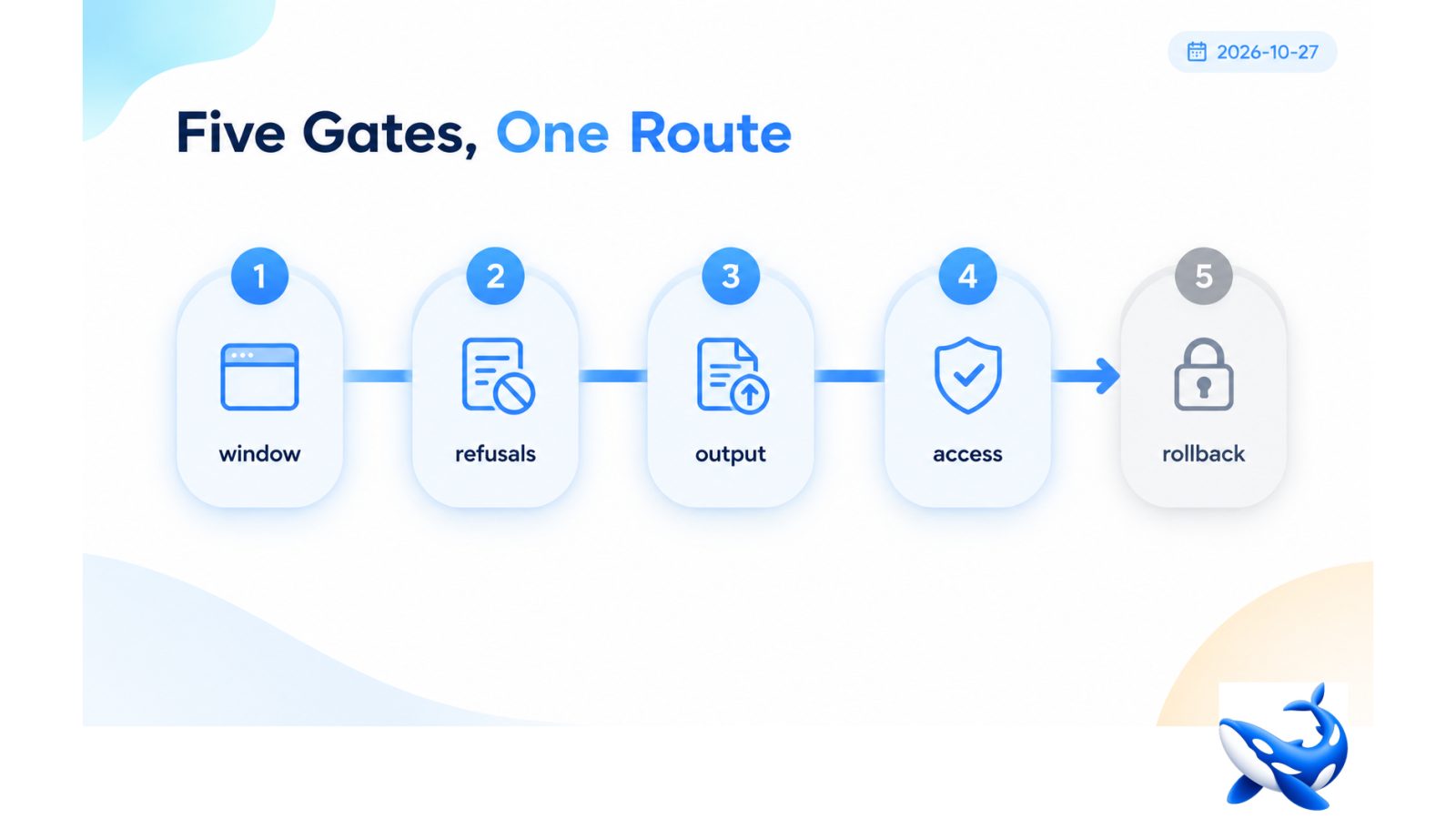
One: does your traffic fit the window?
262,144 tokens [OURS]. Query your logs for the 30-day maximum and the 99th percentile of input tokens.
If the p99 is under 150,000, the window is irrelevant and you can stop worrying about it. If the maximum is over 262,144, you need a routing rule before you start — not after the first failed request.
The base model on the same key has a million-token window, so the rule can be as simple as: over the limit, go to the base.
Two: do your prompts actually get refused?
This is the question the whole purchase rests on, and it is answered by sampling, not by reading. Two hundred real prompts, both models, count the refusals.
Record three outcomes, not two: completed by both, refused by the base and completed by the tuned build, and completed by both but differently. The third bucket is where surprises live — a guardrail you were relying on, a tone that changed, a refusal that became an answer you did not want.
If the second bucket is near zero, stop here and keep the base model.
Three: is the output shape acceptable?
The card publishes 131,072 output tokens, tools, and JSON [OURS]. That is enough for most artifacts, and the schema support means a downstream system can parse rather than guess.
The question to answer is whether your pipeline can consume a structured answer, or whether it currently scrapes prose. If it scrapes, the migration is an opportunity and also a project — price it honestly.
Four: can you get access this week?
Every OrcaCyber card is gated: an engagement, a passkey and acceptance of the terms before the endpoint serves a request [OURS]. That is a procurement sequence with a calendar, and it is the most common reason a launch slips by three weeks.
Start it the day you decide to evaluate, not the day you decide to ship.
Five: can you roll back in one minute?
A model string in a config, behind a feature flag, with the old value retained. If switching back requires a deploy, you do not have a rollback, you have a plan to have one.
The same key reaches both models, so the flag is the only engineering required [OURS]. That is worth doing even if you are confident, because confidence about a one-day-old card is not evidence.
What “yes to all five” still does not give you
It does not give you a reliability number. The card’s production sample is 1,345 tokens, so there is no error rate, no p95, no throughput figure worth quoting [OURS]. You are accepting an unmeasured service.
That is not unusual for a new model, and the mitigation is scope rather than certainty: start at ten percent of traffic, log failures and rework, and raise the share on evidence.
It also does not give you a quality guarantee. The five vendor benchmark rows are dated 2026-08-25 and describe the tuning, not the service [VENDOR].
The ten-percent week
Concretely, what to run for the first week:
• Ten percent of eligible traffic, routed by a hash of the request ID so the same inputs keep landing on the same model.
• Two logs: completion failures, and cases where the answer needed human rework.
• One comparison: the same metrics for the base model over the same week.
• One decision date written down in advance.
At the end of the week you have something no model page can give you: a measured difference on your own workload.
What to do with the result
Three outcomes, three responses.
Better on refusals, equal on quality. Raise the share, keep the routing rule for oversized inputs, and revisit the price at the next renewal.
Better on refusals, worse on quality. Keep it for the refusal-sensitive slice only — a scoped tool rather than a replacement. That is a legitimate outcome and often the right one.
No difference. Revert and keep the base. The five-times input rate buys nothing you can measure, and “we tested it” is a perfectly good closing argument.
Write the outcome down either way. The next model release will arrive in a few weeks, and a record of how this one was evaluated makes the next one cheap to judge.
The question that decides the others
If you only answer one, answer the refusal one. It is the only question whose answer can change the others.
A card that removes refusals your base model was already making is worth a higher price, a smaller window and a new integration. A card that removes nothing is worth none of those, however good its benchmark rows look.
The other four questions describe cost. That one describes value, and the two only meet in the same sentence when you have measured both.
If you cannot answer it yet, the answer is not “probably” — it is “go and sample two hundred prompts”. That is the whole job, and everything else in this article is preparation for it.
Two hundred is a starting number, not a rule. If your traffic is varied, sample across the variety; if it is narrow, a hundred will do.
The takeaway
Five questions: does it fit, does it refuse less, does the output parse, can you get in, can you get out. Four of them you can answer today; the fifth needs a week of sampled traffic.
A model that has existed for one day is not a risk if you route ten percent and read the logs. It is a risk if you route everything and read the benchmark table.
The checklist is reusable. Swap the model name and the numbers and it applies to the next card you evaluate, and the answers accumulate into something no vendor page provides: a record of what your own workload does when you point a new model at it.
Sourcing note: context window, output ceiling, capabilities, pricing and the access gate are from the OrcaRouter model page, checked 2026-10-27 [OURS]. The 1,345-token weekly volume is OrcaRouter production telemetry for the seven days ending 2026-10-26 and supports no latency or reliability claim [OURS]. Benchmark rows are the vendor’s own, evaluated 2026-08-25 [VENDOR].