Heavy Transport Engineering: When a Few Centimetres Make All the Difference
ADVERTISEMENT
Moving a piece of industrial equipment weighing several hundred tonnes sounds like a problem that can be solved with a sufficiently powerful vehicle. In reality, the weight is often only the beginning of the challenge. An oversized load must negotiate corners, pass buildings and roadside obstacles, cross surfaces with limited bearing capacity and reach its destination without compromising safety.
Sometimes the difference between a successful operation and an expensive delay comes down to a few centimetres.
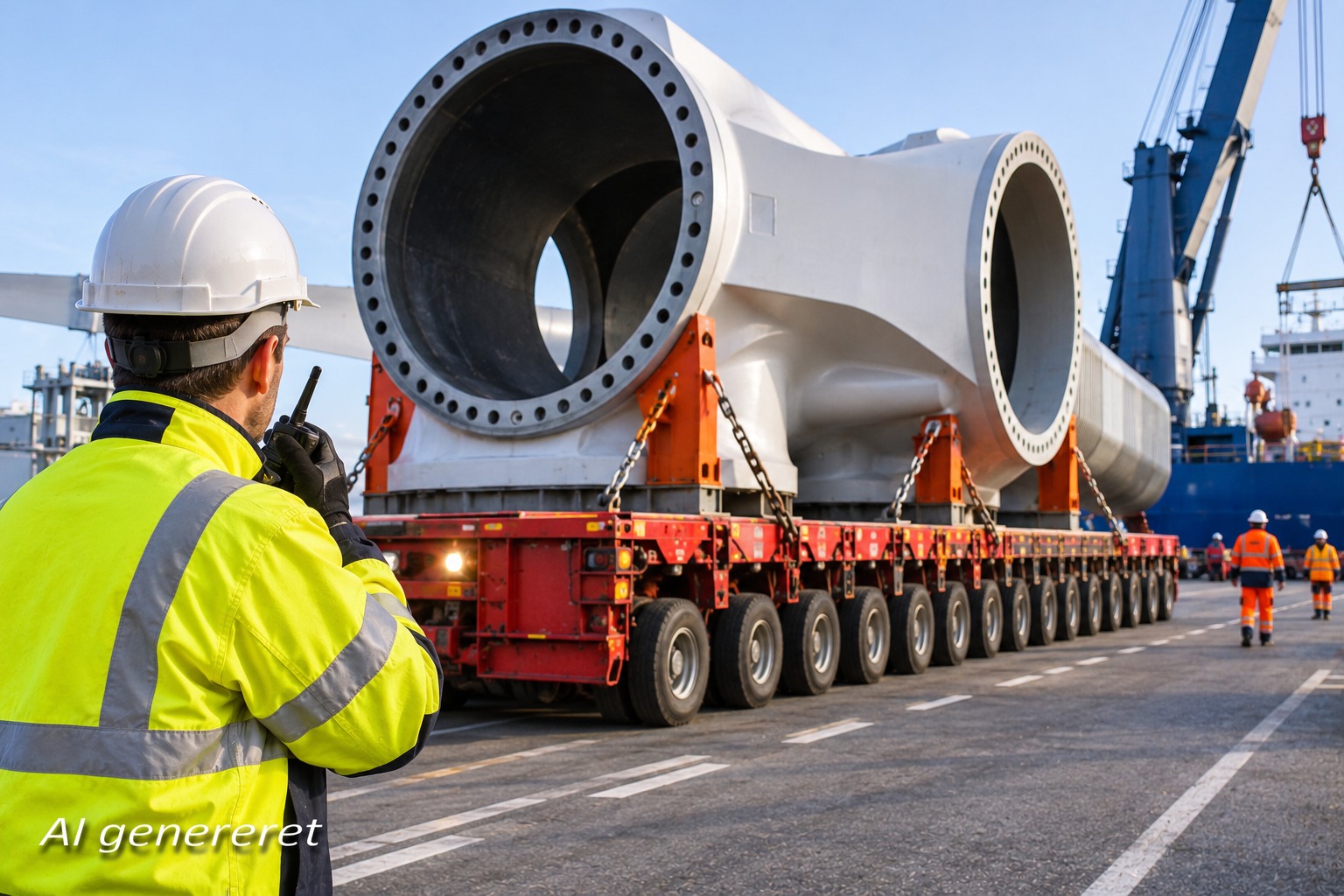
In March 2025, Blue Water Shipping reported moving a 300-tonne blade yoke through the Port of Esbjerg in Denmark. The component measured 24 metres long, 10 metres wide and 17 metres high. Along parts of the route, the available clearance was less than five centimetres. The operation required detailed route surveys, transport calculations, infrastructure adjustments and careful coordination before the equipment could be moved.
It is an example of why heavy transport is as much an engineering discipline as a logistics service. The challenge is not simply to carry an extraordinary load, but to understand how that load will interact with every part of its surroundings.
Why an Ordinary Route Can Become an Engineering Challenge
A road that easily accommodates everyday traffic may be completely unsuitable for transporting large industrial components. Bridges have load limits, junctions have restricted turning space, and overhead structures can prevent tall cargo from passing. Even a relatively short journey may involve obstacles that require specialist assessment.
For heavy transport engineers, route planning therefore involves far more than identifying the shortest distance between two locations. A route survey examines potential obstructions, road geometry, surface conditions and the infrastructure that could be affected by the movement. Engineers may then conduct swept-path analyses to understand how a long or wide vehicle will behave while turning, particularly when its front and rear sections follow different paths.
Blue Water Technical Engineering Consulting A/S, known as Blue Water TEC, provides heavy transport engineering for complex industrial and infrastructure projects. Its services include axle-load assessments, stability checks, transport configuration studies and route feasibility analysis, helping project teams determine how oversized equipment can be moved using suitable machinery and practical operating procedures.
These assessments can reveal the need for temporary alterations before transportation begins. Depending on the route, this might involve removing signs, modifying access points or coordinating restrictions with the relevant infrastructure owners. Such interventions must be carefully planned because the transport operation still needs to account for normal site activities, surrounding traffic and public safety.
Specialised Transporters Need Equally Specialised Planning
One of the most recognisable technologies used for exceptional loads is the self-propelled modular transporter, commonly called an SPMT. Rather than relying on a conventional truck and trailer combination, an SPMT uses multiple axle lines and independently controlled steering arrangements to move extremely heavy or awkwardly shaped cargo.
Its modular design allows transport configurations to be adapted to different loads. However, adding more axle lines does not automatically guarantee a safe movement. Engineers must still determine how the weight is distributed, whether the cargo is adequately supported and how the transporter will behave during acceleration, braking and turning.
The surface beneath the vehicle is equally important. A heavy load may impose substantial forces on pavement, concrete slabs or temporary working areas, even when distributed across numerous wheels. Engineers therefore assess ground-bearing capacity and local structural limitations before approving a proposed configuration.
The Esbjerg operation illustrates how these calculations translate into practical results. Blue Water used its own SPMT equipment and completed the transport calculations and configuration in-house. After the necessary route preparation, the 300-tonne blade yoke travelled approximately six kilometres through the port in four hours before being loaded aboard an installation vessel the following day.
The achievement was not simply that the transporter could carry the weight. It was that the engineering team had developed a workable arrangement for moving an exceptionally large component through a constrained environment.
Good Engineering Protects More Than the Cargo
The financial consequences of a failed heavy transport operation can extend well beyond damage to the equipment itself. Delays may affect construction schedules, vessel availability, crane bookings and the work of contractors waiting at the destination. For major energy and infrastructure projects, several activities often depend on the timely arrival of a single critical component.
That makes communication and operational supervision important parts of the engineering process. Transport calculations must be translated into clear instructions for drivers, equipment operators and site personnel, while the agreed route and operating conditions need to be checked before movement begins.
Blue Water TEC combines its engineering capabilities with the wider operational experience of Blue Water Shipping. In addition to transport feasibility and equipment selection, it provides technical support during project development and execution, including assessments of lifting and loading operations.
For project owners, the priority should be a transport plan that identifies relevant constraints and explains how they will be managed. This includes suitable equipment, verified route conditions, clearly allocated responsibilities and arrangements for responding if site conditions differ from expectations.
The most impressive heavy transport operations often appear remarkably uneventful to an outside observer. A large component moves slowly around a corner, passes through a narrow opening and arrives precisely where it is needed. Yet that apparent simplicity reflects extensive preparation.
When every centimetre matters, successful transportation depends less on improvisation than on the quality of the engineering decisions made before the wheels begin to turn.