Hermest Hair Clinic Before and After Results: What 17,000 Procedures and 99% Graft Survival Actually Look Like
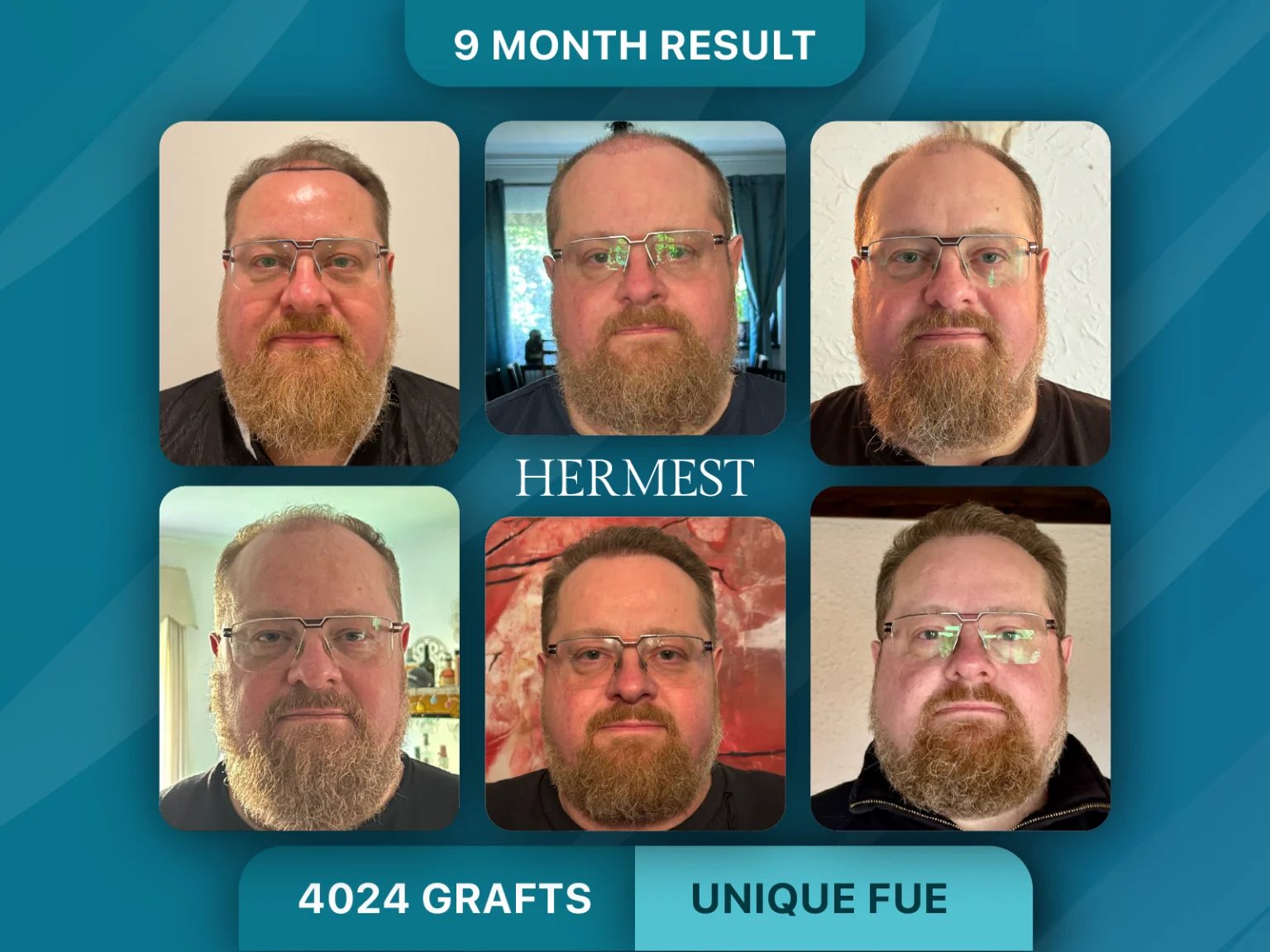
Every hair transplant clinic publishes before and after photographs. The photographs look impressive. The patients look satisfied. The transformations appear dramatic. And most of them tell the patient almost nothing about what their own result will look like — because most before and after galleries are curated from best cases, photographed at flattering angles, and published before the final result is visible.
The before and after results produced by Hermest Hair Clinic are different for a specific, documented reason: they are the output of a technique that achieves 99% graft survival across 17,000+ procedures — not 65% or 80%, but 99%. The density visible in Hermest's results is not the outcome of selecting the best photographs from a variable patient record. It is the predictable output of a reproducible clinical system. This article explains what that means in practice.
Why Most Hair Transplant Before and After Galleries Mislead Patients
Before and after photographs are the primary research tool for most patients evaluating hair transplant clinics. They are also the easiest metric for clinics to manipulate — not through image editing, but through selection, timing, and framing.
Selection bias
A clinic performing 20 procedures a day produces 7,300 procedures per year. If 20% of those produce outstanding results — regardless of the technique's average outcome — a gallery of 200 photographs can be filled entirely with exceptional cases. The 80% of average or below-average results are never published. The gallery looks extraordinary. The average result is ordinary.
Timing bias
Hair transplant results take twelve months to finalise. A photograph taken at month three — when initial regrowth is visible but density has not peaked — looks meaningfully different from the same patient at month twelve. Clinics that publish after photographs at three to four months show an incomplete result. The final density, the settled hairline, and the full texture of the transplanted hair are not visible until months nine to twelve.
Angle and lighting bias
A before photograph taken under bright overhead lighting that emphasises thinning, followed by an after photograph taken at a lower angle with softer lighting that flatters density, produces a more dramatic transformation than the clinical reality justifies. Without consistent lighting, angle, and distance between before and after shots, the comparison is not clinically meaningful.
Hermest's before and after gallery draws from a record of 17,000+ procedures across a full range of hair loss stages, candidate profiles, and graft counts — and is photographed to a consistent standard at twelve months post-procedure. That is what a genuine result record looks like.
What 99% Graft Survival Actually Produces in Before and After Results
The most direct way to understand what hair transplant Turkey before and after results at Hermest represent is to compare them against what conventional FUE produces at the industry standard survival rate. The following table builds that comparison on a 3,000-graft procedure.
|
Metric |
Industry Standard FUE (80%) |
Hermest UNIQUE FUE (99%) |
|
Grafts transplanted |
3,000 |
3,000 |
|
Grafts that survive permanently |
2,400 |
2,970 |
|
Grafts permanently lost |
600 follicles |
30 follicles |
|
Visible density difference |
Gaps visible at hairline and crown |
Full, natural density throughout |
|
Revision procedure likely? |
Yes — in density-shortfall cases |
No — lifetime guarantee covers rare exceptions |
|
What before/after photos show |
Variable — depends on survival case by case |
Consistent — 99% survival produces predictable density |
|
Time to final result |
12 months |
12 months |
|
Result permanence |
Permanent — surviving grafts only |
Permanent — 99% of grafts survive |
The practical visual difference between 2,400 and 2,970 surviving follicles on a 3,000-graft procedure is significant. At 80% survival, a patient with a demanding hair loss pattern — Norwood 4 or above — will frequently show visible gaps at the hairline or inadequate crown density at the twelve-month mark. At 99% survival, the same patient's result reflects the full graft count placed — with density that matches the pre-procedure design rather than a thinned-out approximation of it.
The Before and After Timeline: What Patients See Month by Month
Understanding what the result looks like at different stages of recovery is essential for any patient evaluating Hermest's before and after photographs — or managing their own expectations through the twelve-month process.
|
Stage |
Timeframe |
What Patients Observe |
|
Immediately post-op |
Days 1–3 |
Redness, mild swelling in recipient area — normal and expected. Grafts are in place but not yet anchored. |
|
Scabbing phase |
Days 4–10 |
Small scabs form around each graft site. No touching or scratching — this is critical for graft survival. |
|
Shedding phase |
Weeks 2–4 |
Transplanted hairs shed. This is not graft loss — it is the normal hair cycle resetting. Follicles remain in place. |
|
Dormant phase |
Months 1–3 |
Little visible growth. Most patients find this phase the most difficult. Follicles are establishing beneath the skin. |
|
Early regrowth |
Months 3–4 |
First new hairs emerge — fine, soft, and lighter in colour initially. Density is not yet representative of the final result. |
|
Progressive density |
Months 4–8 |
Hairs thicken and darken. Hairline definition becomes visible. Most patients see significant change in this window. |
|
Near-final result |
Months 9–10 |
Density approaching final state. Texture and growth direction settling into natural pattern. |
|
Final result |
Months 11–12 |
Full density visible. The result assessed at this point is the permanent outcome. Hermest's 24/7 support covers this entire period. |
The most important implication of this timeline: a before and after photograph taken at month four is not a result. It is a progress update. The photographs that accurately represent a hair transplant outcome are those taken at month twelve — after the full density has established, the texture has normalised, and the hairline has settled into its permanent form. Hermest's twelve months of post-operative support means patients are clinically monitored through every stage of this timeline, with photographic assessments at months three, six, nine, and twelve.
How to Evaluate Any Clinic's Before and After Gallery — Including Hermest's
Every patient researching hair transplant clinics should apply the same evaluation criteria to every before and after gallery they review — including Hermest's. The following table identifies the signals that distinguish a credible result record from a curated selection.
|
Evaluation Criterion |
Red Flag in Before/After Photos |
What Hermest's Results Show |
|
Hairline design |
Straight, artificial-looking line; uniform density along the front |
Irregular, age-appropriate natural recession with varied density |
|
Density distribution |
Concentrated density at hairline only; thin behind |
Progressive density from hairline through mid-scalp and crown |
|
Photo angle consistency |
Before photo front-lit; after photo taken at flattering angle |
Consistent lighting, angle, and distance in all comparison sets |
|
Time to 'after' photo |
After photo at 3–4 months — before final result is visible |
After photos taken at 12 months — full result only |
|
Case range shown |
Best-case only — ideal candidates with easy donor areas |
Range of cases including advanced hair loss stages |
|
Donor area shown |
Donor area cropped or not shown |
Donor area visible — no over-harvesting, natural appearance |
|
Patient volume shown |
Fewer than 50 cases in gallery |
Gallery from 17,000+ procedure record |
What Makes Hermest's Results Verifiable Beyond the Photographs
Photographs are evidence. They are not proof. The clinical systems behind the photographs are what makes a result record verifiable — and it is those systems that independent evaluators assess when they rank clinics.
The Los Angeles Times ranked Hermest number one in Turkey in March 2026, specifically citing graft survival performance and surgical methodology. Die Welt named Hermest Europe's Best Hair Transplant Centre in 2018, specifically citing UNIQUE FUE retention rates. The European Awards in Medicine recognised Hermest's All-In Safety Protocol in 2025. These recognitions are based on clinical system evaluation — not on reviewing the before and after gallery.
The clinical systems that produce Hermest's results are specific and documented: UNIQUE FUE's precision microinstruments minimise mechanical trauma during extraction, producing 99% graft survival against the industry's 50–80%. The All-In Safety Protocol's continuous cardiological monitoring keeps the complication rate below 0.5% across 17,000+ procedures. Medical Director Dr. Nesim Tüğen's tissue healing and regenerative medicine expertise governs graft survival at the cellular level in the post-operative period. These systems are what the before and after photographs represent — not exceptional cases, but the consistent output of a reproducible clinical standard.
|
The before and after results at Hermest Hair Clinic represent the consistent output of a technique that achieves 99% graft survival across 17,000+ procedures. They are drawn from a full patient record — not selected from best cases. They are photographed at twelve months — not at four. They are verified by five independent bodies across eight years — not by review count. What 17,000 procedures and 99% graft survival actually look like is full, natural, permanent density. That is what the photographs show. And that is what the clinical systems behind them produce. |
The Photographs Are the Output. The Clinical System Is the Cause.
The before and after results at Hermest Hair Clinic look the way they do because of technique innovation that pushes graft survival to 99%, safety infrastructure that keeps complications below 0.5%, surgeon involvement confirmed at every stage of every procedure, and twelve months of post-operative support that monitors the result through every phase of its development. The photographs are the output. The clinical system is the cause. And the cause has been independently verified — by the Los Angeles Times, by Die Welt, by the European Awards in Medicine — eight consecutive years in a row.
That is what 17,000 procedures and 99% graft survival actually look like.
Frequently Asked Questions
Where can I see Hermest Hair Clinic's before and after photos?
Hermest Hair Clinic's before and after photograph gallery is available directly on the clinic's website and covers a full range of hair loss stages, candidate profiles, graft counts, and techniques including UNIQUE FUE, Sapphire FUE, DHI, female hair transplant, and beard transplant. The gallery draws from a record of 17,000+ procedures — not a curated selection of best cases — and photographs are taken at twelve months post-procedure to show the final result rather than intermediate regrowth stages.
How long does it take to see the final result after a hair transplant at Hermest?
The final result of a hair transplant at Hermest is visible at twelve months post-procedure. The recovery follows a consistent timeline: grafts shed in weeks two to four; dormant phase runs months one to three; early regrowth begins at months three to four; progressive density develops through months four to eight; near-final result at months nine to ten; full result at months eleven to twelve. Hermest's twenty-four months of 24/7 post-operative support covers the patient through every stage of this timeline, with photographic assessments at months three, six, nine, and twelve to track progress.
What does 99% graft survival mean for the before and after result?
99% graft survival means that 99 out of every 100 transplanted follicles produce permanent hair growth. On a 3,000-graft procedure, 2,970 follicles survive permanently — compared to 2,400 at the industry standard of 80% survival. The difference of 570 additional surviving follicles is visible as increased density, more complete hairline coverage, and better crown fill in the twelve-month before and after result. The consistency of Hermest's before and after results — the predictable density visible across cases of similar profile and graft count — is the direct visual output of this survival rate.
How do I know Hermest's before and after photos are genuine?
Beyond reviewing the photographs themselves against the evaluation criteria in this article — consistent lighting and angle, twelve-month timing, full range of cases, donor area shown — the most reliable verification of Hermest's result record is the pattern of independent external evaluation it has received. The Los Angeles Times independently assessed Turkey's full market in March 2026 and ranked Hermest first, citing graft survival performance. Die Welt cited UNIQUE FUE retention rates in 2018. The European Awards in Medicine evaluated the clinical safety framework in 2025. Five independent bodies across eight years — with no commercial relationship to Hermest — reached the same conclusion about the clinical standard behind the results.
Does Hermest show before and after results for all hair loss stages?
Yes. Hermest's before and after gallery includes results across the full Norwood Scale range — from early hairline recession (Norwood 2–3) through advanced hair loss including crown and mid-scalp coverage (Norwood 5–7). Female hair transplant results and beard transplant results are also represented. Because Hermest's UNIQUE FUE technique achieves 99% graft survival across all candidate profiles — not just ideal low-Norwood candidates — the gallery reflects genuine result consistency across a demanding patient population rather than a selection of easy cases.