How to Protect Your Organization From Zombie Scrum?

Scrum was created to enable teams to learn quickly and rapidly, change their mindset quickly, and provide the most value. In many organizations nowadays, Scrum exists only on paper. Teams are present at meetings or update boards and adhere to rituals, but progress seems slow and disengaged in fulfilling customer needs.
Research from Scrum.org and The Zombie Scrum Survey, which analysed responses from more than 3,500 Scrum teams around the world, demonstrates that the majority of teams have issues with stakeholder engagement, a lack of increment usage, and a lack of a strong improvement culture.
These statistics confirm that one important fact: Zombie Scrum is no longer acceptable and has become a major organization-wide risk. In this article, we will learn about ways to safeguard your company from the threat of zombie Scrum step-by-step.
What Is Zombie Scrum?
| What is called a zombie?:
A zombie is something that looks active or alive but isn’t really working properly. It keeps moving or existing, even though it has no real purpose or value anymore. |
Zombie Scrum is when a team follows all the rituals of Scrum (like meetings and roles) but has lost its real purpose, engagement, and delivering valuable, working software, making it a lifeless process instead of an agile way to build things.
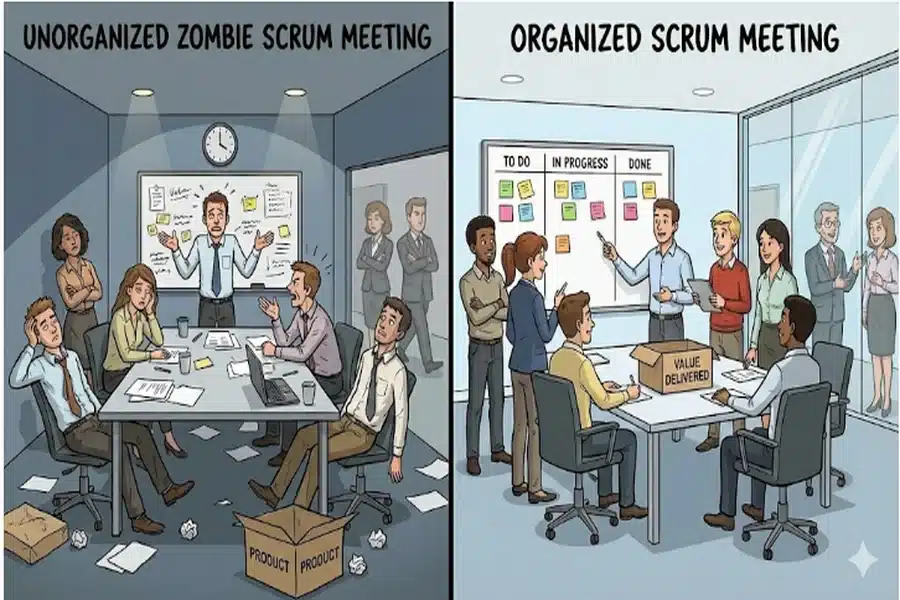
Zombie Scrum teams “look alive from a distance” but lack learning, adaptability, and value delivery. Organizations fall into Zombie Scrum when they prioritize efficiency, predictability, and control over learning and adaptation.
| Zombie Scrum is Scrum without a “beating heart.” |
That beating heart is a
- Done Increment
- Working product delivered frequently
- Validated with real users
Without these, Scrum is just like a checklist instead of a way to solve complex problems.
Key Symptoms of Zombie Scrum
Recognizing Zombie Scrum early helps prevent long-term damage. The most common symptoms include:
1. Absent or Uninvolved Stakeholders
Teams rarely interact with real stakeholders or customers. Feedback is missing or comes too late. Decisions are based on assumptions, not evidence.
2. No Done Increment
Sprints end without releasable work. Releases take months, not days. “Almost done” becomes the norm, blocking learning and slowing value delivery.
3. No Continuous Improvement
Retrospectives feel boring or repetitive. Action items are ignored. Problems are accepted instead of solved.
4. Lack of Team Autonomy
Teams are constrained by rigid rules, dependencies, and approvals. They cannot decide how best to do their work, which kills ownership and motivation.
Why Organizations Fall Into Zombie Scrum
Zombie Scrum rarely starts with bad intentions. Common root causes include:
Efficiency Over Learning
Organizations mostly optimize for predictability, utilization, and control. Scrum, however, does well on experimentation and adaptation. This clash creates meaningless agility.
Output Over Outcomes
Velocity, story points, and utilization are tracked closely, while customer satisfaction, quality, and business impact are ignored. Teams look successful on dashboards but fail in the market.
Copy-Paste Agile Models
Many companies adopt popular frameworks or models without understanding their context. What worked elsewhere is copied without experimentation, leading to mechanical behavior.
Weak Agile Leadership
Without leadership support, teams lack the safety to challenge the system. Scrum becomes compliance-driven instead of value-driven.
How to Protect Your Organization From Zombie Scrum
The good news: Zombie Scrum is treatable. Recovery requires focus, patience, and system-level thinking.
1. Reconnect With the Purpose of Scrum
Scrum exists to manage risk and discover what works in complex environments. Emphasize early and frequent delivery of Done Increments to validate assumptions and learn fast.
2. Make Work and Problems Visible
Create transparency around delays, dependencies, and quality issues. Bring teams, stakeholders, and leaders together to discuss what hurts and why.
3. Shift Metrics From Output to Value
Challenge metrics like velocity. Instead, focus on lead time, cycle time, customer feedback, and business outcomes. Ask how each metric helps decision-making.
4. Bring Purpose Back to Scrum Events
Every Scrum event should start with a clear goal. Strong Product Goals and Sprint Goals give meaning to Daily Scrums, Reviews, and Retrospectives. Without goals, events lose relevance.
5. Involve Stakeholders Actively
Invite real stakeholders to Sprint Reviews. Let them see working increments and share feedback. This reconnects teams with real-world impact.
6. Build Psychological Safety
Teams must feel safe to speak up, experiment, and fail. Simple facilitation techniques and open dialogue help replace blame with learning.
7. Use Diagnostic Tools
Tools like the Zombie Scrum Survey help teams understand their current state across key dimensions and compare results with other organizations. This creates a shared starting point for change.
How Investing in Structured Training Helps Cure Zombie Scrum?
Investing in a CSM® certification equips teams and leaders with a deep understanding of Scrum’s purpose, values, and practices. It strengthens facilitation, stakeholder collaboration, and continuous improvement—helping organizations move beyond rituals and revive Scrum as a value-driven, learning-focused framework.
Final Thoughts: Sustaining a Healthy Scrum Culture
Protecting against Zombie Scrum is not a one-time fix. It requires continuous attention to learning, leadership behavior, and system constraints. Encourage small experiments, celebrate learning, and regularly inspect whether Scrum still serves its purpose.
When teams deliver real value, stakeholders stay engaged, and improvement becomes natural. Scrum comes back to life. The goal is not perfect Scrum, but meaningful Scrum that helps organizations adapt, learn, and succeed.