The Feminine Macabre: Why Women are Reclaiming the Skull in Jewelry
Picture the skull. For a long time, its story was written by men. It was the emblem of pirates and punks, the gritty insignia of motorcycle clubs and heavy metal bands—a badge of honor for the boys’ club of rebellion. The skull was loud, it was aggressive, and its message was simple: don’t mess with me. But what happens when a symbol so steeped in masculine bravado falls into the hands of women?
It doesn’t just get adopted. It gets reborn.
We’re watching a quiet and captivating cultural shift, a movement that could be called the “Feminine Macabre.” Women are reaching for the skull not just as an accessory, but as a piece of their own narrative, transforming it from a blunt instrument of defiance into a complex and beautiful emblem of a new kind of power. It’s a fascinating alchemy, proving that grace and grit don’t just coexist—they thrive together.
From Rebel Yell to Artistic Whisper
Before the skull was a counter-culture scream, it was a philosophical whisper. For centuries, it served as the central figure in memento mori, a Latin phrase meaning “remember you will die.” This wasn’t a morbid fascination but a profound artistic tradition designed to remind us of our own fleeting time on this earth. As the Tate art museum’s glossary explains, it was a universal nudge to live a life of meaning and virtue. Yet, somewhere in the thunder of the 20th century, that thoughtful message was drowned out. The roar of motorcycle engines and the snarling chords of punk rock recast the skull. It became property of the fringe, an icon of raw, masculine energy.
A Symbol Reimagined
Today, that narrative is being completely rewritten. The rise of the Feminine Macabre sees the skull shedding that old, hardened skin. In the hands of female designers and on the ears, necks, and fingers of women everywhere, the skull is no longer just a stark warning. It’s being intricately carved with floral patterns, cast in the delicate glow of rose gold, and set alight with sparkling gemstones. The hard edges are being softened, not to diminish their power, but to add stunning new layers of meaning.
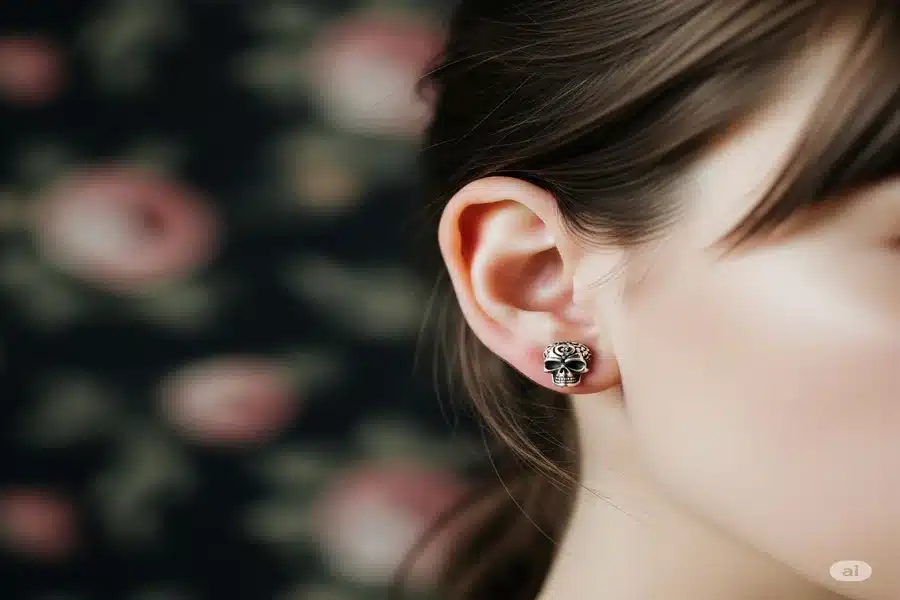
You see it in the subtle flash of small sterling silver skull earrings peeking out from under a curtain of hair. On a woman, they’re not just a punk throwback. They become a quiet testament to her resilience, a personal nod to battles she’s faced. They speak of a woman who understands the fragility of life and chooses to meet the world not with aggression, but with a grounded, knowing grace. When that same skull is intertwined with a flower, it tells an even richer story—that beauty and decay are part of the same breathtaking cycle, and that there is profound strength in embracing it all.
More Than an Accessory: The Meaning Behind the Motif
So, what’s really going on here? This is so much more than a fleeting fashion trend. It’s a direct reflection of a deep cultural current where femininity is finally being allowed its full, glorious spectrum. Women are tired of being handed a script that tells them to be only soft, only nurturing, only accommodating. They are their ambition, their joy, their rage, their sorrow, and their strength, all at once. Is it any wonder they’d be drawn to a symbol that so perfectly holds that duality?
The skull becomes the ideal emblem for this complex identity. It’s a beautiful refusal to be just one thing. It acknowledges life’s shadows and its sharper edges without flinching, and it does so with an undeniable sense of style. The psychology behind this is fascinating; by choosing to wear a skull, a woman signals that she is not afraid of the parts of life often hidden away. She is comfortable with complexity. This is a sophisticated and deeply personal form of self-expression.
The Power of a Beautiful Contradiction
There’s also a delicious power in the way this aesthetic plays with our expectations. A woman in a delicate floral dress or a sharp business suit, finished with the unexpected edge of skull jewelry, creates a compelling visual contrast that is both intriguing and slightly intimidating. It disrupts snap judgments and forces the viewer to look closer. It says, “I am not just one thing. I am beautiful, but I am also fierce. I am gentle, but I am also unbreakable.” This juxtaposition is the very heart of the movement—a visual representation of the complex, powerful, and self-defined woman of the 21st century.
The next time you see a woman wearing a skull, know that it’s probably not an echo of an old, borrowed rebellion. It’s the opening note of a new anthem. And in this version, she’s the one writing all the verses.