
Why Sdg’s Affiliate Crackdown Matters For Online Dating Safety In 2026

Online dating is usually described as a matching business. A user creates a profile, scrolls through possible connections, starts a conversation and hopes the person on the other side is looking for something similar.
In 2026, that description is no longer enough.
Dating platforms are also trust businesses. Their success depends on whether users believe profiles are authentic, complaints are reviewed, commercial partners follow the rules and suspicious behavior is stopped before emotional harm turns into financial loss.
That is why a recent decision by Social Discovery Group (SDG) deserves attention. After allegations of misrepresentation involving an affiliate partner and some accounts on platforms including Dating.com, SDG suspended payments to the partner, prevented it from establishing new user connections and appointed an external firm to investigate. The affiliate has not been publicly identified, and the inquiry has not yet produced final findings.
That distinction matters. Allegations are not proof.
At the same time, freezing payments and stopping new activity are concrete actions. They show a company interrupting revenue while the evidence is examined rather than allowing normal business to continue until every question has been answered.
Inside the article: Why the decision matters · What SDG did · Key figures · American dating trends · The role of verification · What users should look for · Final thoughts
Why This Decision Is More Important Than It Looks
Affiliate relationships are common across digital industries. Outside partners may help a platform enter new markets, reach specialized communities or attract users who would be difficult to reach through traditional advertising.
The model can support growth. It can also create risk.
A user does not normally know which outside business helped recruit or support a profile. From the user’s perspective, the experience belongs to the consumer-facing platform. If something goes wrong, people remember the name displayed at the top of the page, not a company listed several layers down in a commercial agreement.
That is why suspending affiliate payments is meaningful.
It changes the incentive immediately. The affiliate cannot continue receiving normal compensation while the disputed conduct is examined. Preventing new connections also limits the number of additional users who might be exposed if the allegations are eventually confirmed.
Social Discovery Group (SDG) has said that it does not permit profiles in which the person shown is different from the person operating the account. It also says licensed likenesses cannot be used as substitutes for genuine users. Every profile is expected to represent a real individual who personally controls it.
The outside investigation must now determine whether those rules were followed.
A Practical Response Instead of a Vague Promise
Technology companies frequently respond to controversy with carefully worded statements. They promise to review the situation, emphasize existing policies and avoid discussing specific consequences.
SDG’s response went further in several practical ways:
- Payments to the affiliate were suspended.
- The affiliate was stopped from connecting with new users.
- An external firm was appointed to investigate.
- The company publicly repeated its rule that a profile must be operated by the person depicted.
- Existing fraud controls and compensation figures were disclosed.
These steps do not settle the underlying claims. They do, however, demonstrate a response built around risk containment.
This is especially important in online dating because users may spend weeks or months building emotional trust. A questionable product review can cost someone the price of an appliance. A deceptive dating interaction can affect savings, confidence, family relationships and mental well-being.
When the possible harm is personal, the company’s response has to be more than personal-relations language.
Social Discovery Group and Dating.com in Numbers

| Publicly reported metric | Figure | Why it matters |
| Suspected scam or fraud accounts closed in 2025 | More than 30,000 | Shows the scale of company-reported enforcement activity |
| Compensation paid in 2025 | $370,000 | Indicates financial remedies in cases where expected standards were not met |
| Identity-verification renewal | Every six months for free users | Treats identity checking as an ongoing process |
| Wider SDG network | 500 million-plus users | Gives the group a large data and technology base |
| Countries covered | 150 | Reflects a genuinely international operating environment |
| Communication platforms | 60-plus | Creates broad reach as well as significant moderation complexity |
| Experts across the ecosystem | 1,200-plus | Provides shared resources in technology, communication and operations |
| Annual SDG Lab investment fund | $20 million | Supports new social-discovery, AI and communication products |
| Dating.com geographic availability | 150-plus countries | Allows users to build international and cross-cultural connections |
The account-closure, compensation and verification figures were provided by SDG in its public statement. The network, platform, staffing and investment figures come from company materials describing SDG’s ecosystem and venture studio. These are company-reported milestones rather than independently audited monthly active-user totals.
Dating.com’s current website promotes profiles across more than 150 countries, government-ID verification signs, dedicated anti-scam systems, video chat, voice messages and instant translation.
What the U.S. Data Says About the Risk
The safety issue is not theoretical for American users.
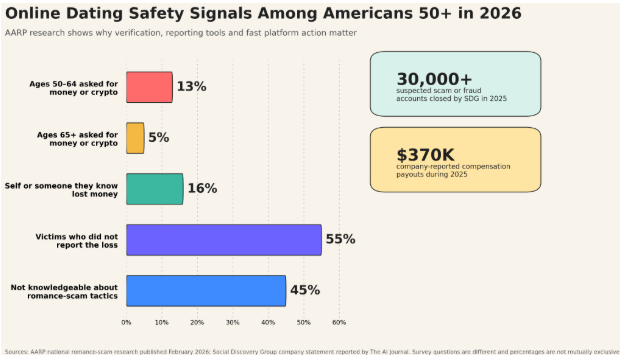
AARP research published in February 2026 found that nearly one in 10 Americans age 50 and older — approximately 11 million people — had formed what appeared to be an online romantic connection that eventually produced a request for money or an invitation to invest in cryptocurrency.
The rate was not the same across age groups.
Among adults ages 50 to 64, 13% reported receiving this kind of solicitation. Among people age 65 and older, the figure was 5%. AARP also found that 16% of adults over 50 said they or somebody they knew had lost money through a romance scam.
Reporting remains another major problem.
More than half of respondents who had lost money — 55% — said they never reported the incident. Forty-five percent of adults over 50 said they were not knowledgeable about common romance-scam tactics.
That combination creates an attractive environment for criminals: substantial financial resources, emotional trust, limited reporting and a knowledge gap about the latest methods.
U.S. online-dating safety signals in 2026
The Bigger 2026 Trend: Clarity Is Replacing Games
Safety is only one part of the current dating story.
American users are also becoming less tolerant of vague intentions and endless mixed signals. Tinder’s 2026 trend forecast describes this change as “Clear-Coding”: people stating what they want, showing emotional availability and relying less on confusing dating behavior. The company says young singles are entering 2026 with greater interest in honesty, confidence and direct communication.
This can be seen in ordinary profile language.
Instead of writing “just seeing what happens,” users increasingly explain whether they want a committed relationship, casual dating, international communication or virtual companionship. Clearer profiles may reduce the number of matches, but they can improve the relevance of the conversations that remain.
Friends are also becoming more involved. Tinder calls this “Friendfluence,” reflecting how users consult friends about profiles, messages and early dating decisions.
This is not entirely new. Friends have always discussed dates. The difference is that modern communication makes it easy to share screenshots, request a second opinion and perform a basic safety check before meeting.
The best result is not a committee choosing somebody’s romantic partner. It is another trusted person noticing a detail that the user may overlook while emotionally involved.
Americans Want Authenticity, but Many Still Feel Pressure to Perform
Online dating profiles have traditionally rewarded polish.
People choose their best photographs, improve their biographies and try to appear confident even when they feel uncertain. In 2026, that level of presentation is creating its own fatigue.
Hinge reported that 63% of Gen Z daters feel pressure to appear more put-together than they really are, compared with 57% of millennials. Its relationship experts argue that profiles often work better when they contain realistic details, developing interests and small imperfections that give another person something genuine to respond to.
The lesson is practical.
A profile that says “I love travel, music and good food” could belong to almost anybody. A profile that says “I am learning to cook Thai food and have so far produced one excellent curry and three minor kitchen emergencies” feels more human.
Smaller signs of affection matter as well.
Bumble reported that 88% of U.S. women include behaviors such as sending memes, sharing playlists or developing private jokes in their modern definition of love and affection.
For dating platforms, this means communication quality matters at least as much as match volume.
Users want spaces where a conversation can develop through text, voice and video rather than being pushed immediately toward another swipe.
AI Is Becoming a Dating Assistant — but Users Do Not Want It to Become the Date
Artificial intelligence is now present throughout the dating process.
People use it to rewrite profiles, check the tone of messages, suggest questions and plan dates. The important 2026 trend is that many users accept AI as support while rejecting it as a substitute for authenticity.
Hinge found that 52% of Gen Z daters who use AI employ it to “vibe-check” messages before sending them. Sixty-nine percent said they were comfortable or neutral about AI helping plan a date.
The boundary becomes much clearer around identity.
Eighty-eight percent of Hinge daters said they were uncomfortable with AI-generated profile photographs. The platform’s guidance is simple: use AI as a second opinion, not as a ghostwriter or a replacement personality.
This distinction is directly connected to safety.
An AI tool helping someone turn “Want to get coffee?” into a warmer invitation is relatively harmless. An AI-created photograph, synthetic voice or automated persona used to misrepresent the account operator is a different matter entirely.
Safe dating platforms need rules that recognize that difference.
Why Reverification Matters
Many people think identity verification is completed once, during registration.
That approach is no longer sufficient.
A legitimate account can later be stolen, sold or accessed by someone else. Password reuse, phishing and device theft can all place an originally authentic profile under different control.
The SDG policy described in the investigation report requires enhanced verification for free users and renewal every six months. The process can involve government-issued identification and biometric liveness checks through Sumsub. Verification remains optional for paid users.
Recurring checks do not prove that somebody has good intentions. They are not personality tests.
They do make it harder for one person to create an account, pass a check and transfer control indefinitely without further review.
Dating.com also displays verification signs for members who have provided government-issued identification. Its website highlights dedicated anti-scam systems alongside video chat, voice messages and international translation.
These features can help users gather several trust signals rather than relying on one photograph or one badge.
What a Safer Dating Platform Should Provide
No dating service can guarantee that every member is honest. People can pass an identity check and still behave badly.
A responsible platform should nevertheless provide several layers of protection:
| Safety layer | What users should expect |
| Identity checks | Clear information about how profile verification works |
| Repeated verification | New checks when badges expire or account behavior changes |
| Automated monitoring | Detection of money requests, repeated scripts and suspicious activity |
| Human review | Trained staff examining reports and automated alerts |
| Visible reporting tools | A simple way to block and report suspicious users |
| Partner controls | Audits and enforceable rules for affiliates and contractors |
| Transparent pricing | Clear explanations of paid communication features |
| User education | Warnings about financial requests and off-platform pressure |
| Financial remedies | A defined review process when platform standards fail |
| Law-enforcement cooperation | Preservation and referral of evidence in serious cases |
Social Discovery Group (SDG) says its AI-powered monitoring analyzes communication for suspicious activity and sends flagged cases for human review. The company also says lessons from incidents are applied to product updates, partner audits and staff training.
That feedback loop is important.
A safety system should not only remove one account. It should learn what allowed the account to operate and make similar activity easier to identify elsewhere.
Why Scale Can Become a Safety Advantage
Social Discovery Group (SDG) reports a network of more than 500 million users across over 60 communication platforms and 150 countries.
Operating at that scale creates an obvious challenge. The group must enforce standards across different languages, markets, legal systems and commercial partnerships.
It can also create an advantage.
A suspicious pattern found on one platform may help security teams recognize similar behavior on another. Repeated message scripts, linked devices, account characteristics and attempts to move conversations toward financial requests can potentially be compared across a broader ecosystem.
This is where size becomes useful only when the organization shares information internally and acts on it.
A large company that detects problems but allows business incentives to override enforcement gains little from scale. A company that can suspend payments, stop new activity and update controls across multiple services can turn its network into a defensive asset.
What American Users Should Do
The company carries responsibility for the platform. Users still benefit from a few clear rules.
Keep the first conversations inside the service. Platform messaging gives moderation teams more evidence if something goes wrong.
Use live video before making travel plans. Video is not perfect proof, but repeated refusal is an important warning sign.
Never send money, gift cards or cryptocurrency to a person known only through an online relationship.
Be cautious about immediate emotional intensity. A person can be enthusiastic without declaring permanent love after three conversations.
Ask a friend for a second opinion. This is especially useful before transferring money, traveling or sharing sensitive documents.
Check whether the platform offers identity verification, accessible support, clear payment information and a visible reporting process.
Dating.com publicly advises users to meet in public, inform a trusted person, arrange safe transportation and report suspected scams.
These precautions are not signs of pessimism. They allow real connections to develop without requiring blind trust at the beginning.
What Social Discovery Group Needs to Show Next
The initial action was a meaningful step. The next stage is transparency.
When the external investigation ends, users will want to know whether rules were broken, how many people may have been affected and what changed as a result.
The most useful public response would explain:
- what control failed;
- how the problem was discovered;
- whether users received compensation;
- whether affiliate contracts were changed;
- whether verification requirements were strengthened;
- how similar problems will be detected earlier.
The name of the affiliate may attract the most attention. The stronger business question is whether the system has been improved.
A good investigation does more than assign blame. It identifies the conditions that allowed a problem to develop.
Online dating in 2026 is becoming more direct, more international and more technologically advanced.
Users are clearer about intentions. They are using AI to improve messages while rejecting synthetic identities. They expect video, translation, detailed profiles and convenient virtual communication.
They also expect companies to take responsibility when trust is placed at risk.
Social Discovery Group (SDG) made an important decision by suspending payments, stopping an affiliate from creating new connections and turning the inquiry over to an external firm. It did not wait for the issue to disappear on its own.
That does not predetermine the investigation’s outcome. It does show the kind of action a large platform should take when credible concerns arise.
The safest dating site is not the one that claims bad actors never appear. That promise would be unrealistic.
It is the platform that verifies identities, watches for suspicious behavior, gives users clear reporting options, controls its partners and is willing to interrupt revenue when something may be wrong.
In an industry built around human connection, trust is not a marketing feature.
It is the product.