How to Choose the Right Compact Tractor Size for a Small Property
Buying the wrong compact tractor is one of the most expensive mistakes a small-property owner makes. Not too little wrong, either. People routinely buy a 25-horsepower sub-compact for a 20-acre pasture and spend the next five years cursing the machine every time they need to bush-hog a thick stand of Johnson grass. Others drop $40,000 on a full-sized utility tractor for a 3-acre hobby farm and then can’t turn it around without taking out a fence post. Size matching matters more than brand, more than color, and more than the monthly payment.
This guide gives you a practical framework to match horsepower and attachment capacity to your actual acreage, terrain, and task list before you ever set foot on a dealer lot.
Why Small-Acreage Properties Are Booming
The audience for compact tractors has never been bigger. According to the USDA, the 2022 Census of Agriculture counted roughly 800,000 farms under 50 acres in the U.S., making that the single largest farm-size category in the country. That figure does not even include the enormous number of rural residential properties, horse properties, and gentleman farms that sit outside the census definition of a working farm but still need a tractor.
Texas alone accounts for a massive share of those small holdings, particularly in the counties ringing the DFW Metroplex, where former crop acreage has steadily converted to rural residential use. The buyer profile has shifted: you are just as likely to be a software engineer with a weekend cattle operation as a third-generation row-crop farmer. The USDA data from the 2022 Census of Agriculture, published at ers.usda.gov, confirms that small-farm operations under 50 acres now represent the dominant segment of the U.S. farm count. That shift directly explains why compact tractor sales have grown faster than any other tractor category over the past decade.
The Size-Task-Attachment Framework
Most buying guides tell you to “match horsepower to acreage.” That is a start, but it misses two-thirds of the decision. The real framework has three legs: size, task, and attachment.
Size is your usable acreage plus your tightest working space. A 15-acre property with a 200-foot equipment barn and wide-open pasture behaves completely differently from a 15-acre property with a narrow grove and a low-clearance lean-to shed.
Task is your heaviest, most frequent job, not your lightest. If you mow twice a month but grade a gravel driveway twice a year, the grading sets the requirement. Box blades and rear blades are drag-your-feet heavy. The tractor has to win that fight.
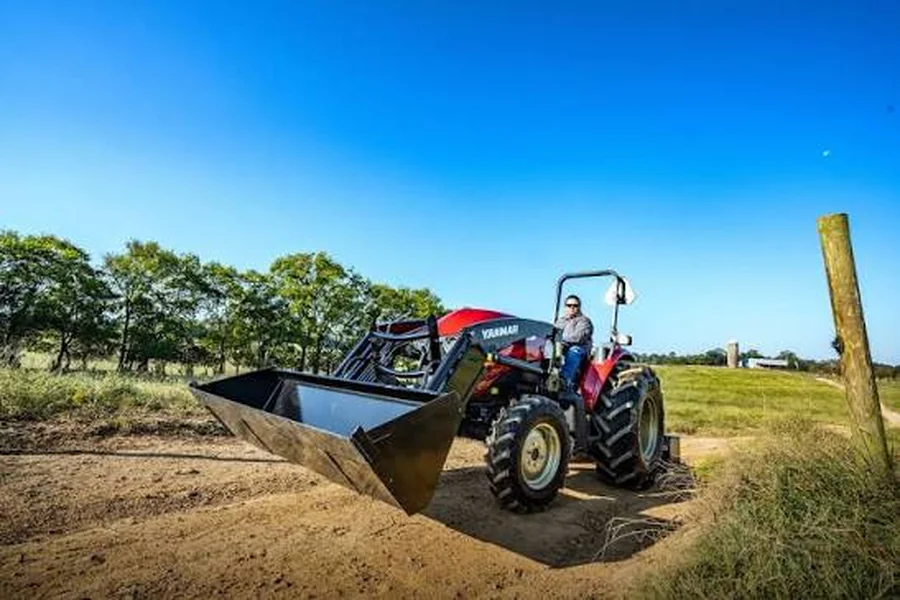
Attachment is where most buyers undersell themselves. A sub-compact in the 20 to 25 HP range handles a 54-inch mid-mount mower beautifully but will shake and labor with a loader bucket full of wet mulch. Compact utility tractors in the 40 to 60 HP range carry both jobs without complaint. The tipping point is almost always loader work, not the mowing.
Horsepower Ranges, Honestly Mapped
Here is how the segments actually break down for small-acreage use. These are real-world generalizations, not manufacturer marketing ranges.
| HP Range | Best-Fit Acreage | Strongest Use Cases | Watch Out For
|
|---|---|---|---|
| Under 25 HP | 1 to 5 acres | Lawn mowing, tilling garden beds, light hauling | Struggles with heavy loader work and thick brush |
| 25 to 40 HP | 5 to 20 acres | Bush hogging, loader work, box blade grading, post-hole digging | Slow in tall or wet conditions above 15 acres |
| 40 to 60 HP | 20 to 50 acres | Full-size loader, rotary cutter, hay baling small bales, finish grading | Tight spaces, low-clearance structures |
| 60+ HP | 50+ acres or heavy implement work | Large baling, deep tillage, commercial mowing contracts | Overkill cost for purely residential use |
My honest recommendation for the majority of DFW-area small-acreage buyers sitting on 10 to 25 acres of mixed pasture and yard? Buy at the top of the 35 to 45 HP range. You will not regret the extra power. You will regret buying light.
A Real Scenario: The 12-Acre Property in Weatherford
Picture a buyer with 12 acres in Parker County, west of Fort Worth. The back half is rough coastal Bermuda pasture with cedar encroachment. The front three acres are yard and a gravel circular drive. There is a 14-foot equipment shed door.
A 25 HP sub-compact clears that shed door easily, but it will not push through dense cedar and won’t carry a full bucket of gravel reliably. A 60 HP utility tractor handles every task but costs $15,000 more and will not fit under that shed door without removing a front loader.
The answer is a 40 to 45 HP compact utility tractor, 4WD, with a mid-mount PTO and a loader rated for at least 1,200 pounds. That machine mows the yard, cuts the pasture, grades the driveway, and fits in the shed with a foot to spare. You can source that exact configuration from a DFW compact tractor specialists who carry multiple brands in that HP range and can walk you through attachment compatibility before you commit.
“The single most common mistake we see is buyers who size down to save money on the purchase price and then end up buying a second, larger machine two years later.” This community consensus among equipment dealers is echoed repeatedly in professional agricultural forums and aligns with every experienced small-farm operator’s advice: buy for your biggest job, not your average one.
Four Questions to Ask Before You Buy
Walk through these before you contact any dealer. Your answers will narrow the field faster than any spec sheet.
- What is my single heaviest task? Grade heavy soil, move large rounds of hay, or mow only? The answer sets your minimum HP floor.
- What is my tightest working space? Measure your shed door, gate width, and any low-hanging structures. Width and height constraints eliminate entire product lines immediately.
- Do I need 4WD? If your property has any slope, any wet season soft spots, or any towing load, the answer is yes. 2WD compact tractors exist, but in Texas clay, they are a frustration machine.
- What attachments will I run in year three, not just year one? Most buyers add a box blade, a rear blade, or a post-hole digger within two years. Factor those into your tractor’s hydraulic flow and rear hitch capacity now.
The Equipment Investment That Keeps Paying
A compact tractor on a well-maintained small property is not a luxury. It is infrastructure. According to the U.S. Bureau of Labor Statistics, employment of agricultural equipment operators is projected to increase 10 percent, faster than the average for all occupations, reflecting how broadly mechanization is expanding across the agricultural sector. That trend reaches well below commercial farming: it includes the growing category of small-acreage rural residential owners who are doing work themselves that previous generations hired out. Owning the right machine on a property in the 5 to 50 acre range pays back in avoided contractor costs within a few seasons. You just have to buy the right size. The BLS data, available at bls.gov, projects that equipment operator roles will grow faster than any other agricultural worker category through the next decade.
Get the size wrong and you will either spend Sunday afternoons fighting a machine that is not strong enough for the job, or you will be paying interest on 20 extra horsepower you never needed. Get it right and the machine becomes the best employee on your property: always available, never late, and perfectly suited to the work in front of it.