
Net Worth Deep Dive: The Rising Stars of the Streaming & Gaming World
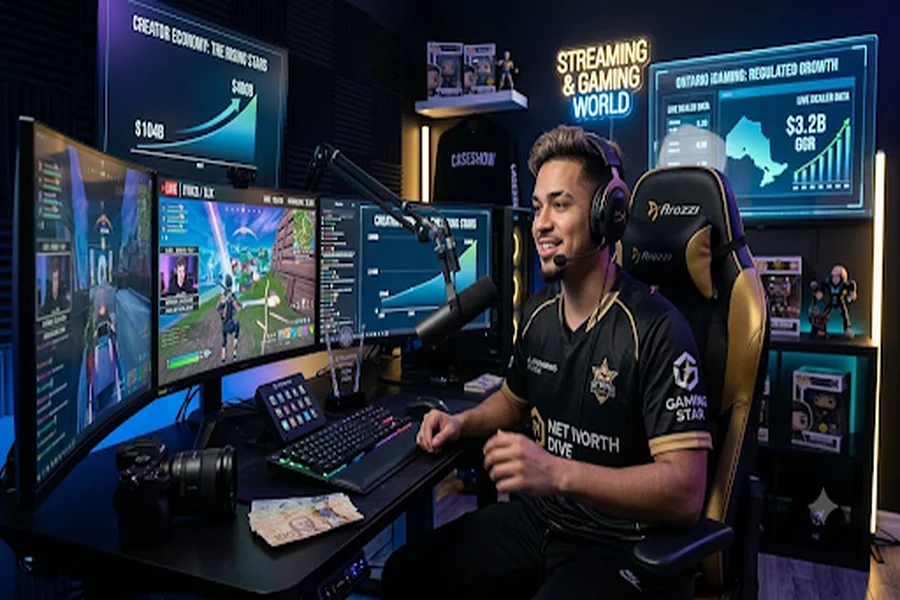
The Billion-Dollar Casino of Human Attention
Let’s be real—the era of the socially awkward gamer broadcasting from a dusty basement for spare change died years ago. Today’s digital entertainment space operates as a hyper-optimized, multi-billion-dollar machine. Industry heavyweights like Goldman Sachs project this entire sector will easily approach $480 billion by 2027. The reality is that individual streamers no longer function simply as entertainers. They operate as vertically integrated media conglomerates.
Wealth distribution inside this creator economy is brutal. You have a massive underclass making absolute pennies. Meanwhile, the top 0.1 percent—roughly 5,000 broadcasters globally—routinely pull down seven-figure annual incomes. These digital elites generate immense capital by mastering a web of platform algorithms, multi-tiered monetization traps, and venture-backed esports contracts.
The battleground for this baseline wealth is the ongoing platform war. Twitch recently caved to market pressure and killed its restrictive $100,000 cap on 70/30 revenue splits for top-tier partners. Kick entered the arena swinging a massive club with an absurd 95/5 revenue split. Stake.com subsidizes that entire Kick operation through offshore casino revenue. YouTube, on the other hand, leverages its search algorithm to turn old video-on-demand content into a passive income pipeline. The catch? You must build an audience rabid enough to pull out their credit cards.
Jynxzi’s $6 Million Tactical Siege
Nicholas Stewart completely shattered the standard Twitch hierarchy between 2023 and 2025. The internet knows him exclusively as Jynxzi. His liquid wealth currently hovers around the $6 million mark; a fortune built almost entirely on his mastery of the tactical shooter Rainbow Six Siege.
Look closer and the raw data behind his ascent is terrifying. Jynxzi hit a statistical anomaly in early 2024 with nearly 180,000 active monthly subscribers. A leaked dashboard later confirmed the math on this phenomenon, exposing a direct Twitch payout of almost half a million dollars for a single 30-day cycle. Frankly, that staggering number only accounted for base subscriptions and programmatic ads. It completely ignored his external sponsorships, massive YouTube AdSense checks, and direct viewer tips.
You must respect the sheer mechanical efficiency of his operation. The guy takes his most chaotic TikTok moments—feeding an audience of 9.5 million—and weaponizes that algorithm to fill his Twitch lobbies. A dedicated team immediately splices those live sessions for YouTube. They sit there permanently, racking up nearly half a million clicks each time. His portfolio includes a top-tier contract with Spacestation Gaming alongside G FUEL money, meaning the kid operates with the profit margins of a Silicon Valley startup. He famously bought a $200,000 Porsche 911 for his father, a very public flex of his new digital reality.
Sketch, Memetics, and the Mainstream Crossover
Elijah Peter Best represents a completely different psychological trigger for digital wealth. This former real estate hopeful abandoned property lines for Madden NFL 24 and accidentally conquered pop culture under the alias Sketch. His bank accounts sit comfortably between $1 million and $5 million today.
He did not get rich through elite gameplay. Sketch weaponized physical mannerisms and a specific catchphrase—”What’s up, brother?”—that breached the digital containment zone. Professional athletes, mainstream celebrities, and random kids on the street started mirroring his tics. That kind of cultural penetration immediately translates into hard digital currency. His highly condensed, intensely loyal Twitch audience converts from casual viewers to paying subscribers at a freakishly high rate.
The true genius of his operation is his bridge to legacy sports institutions. The Houston Texans drafted him to announce their fourth-round pick on live television. He stood in the goal at Wembley Stadium for the globally broadcast Sidemen Charity Match. These massive real-world crossovers allow him to command premium sponsorship rates. Blue-chip corporate giants like AT&T frequently cut him checks for $40,000 a month just to tap into his community.
Clix Bought the Boardroom
The gaming world knows Cody Conrod strictly as Clix. Very few teenagers secure seven-figure bank balances before high school. Cody literally fought his way out of the absolute meat grinder that was early competitive Fortnite to pull it off. Public prize ledgers track his raw tournament payouts at roughly $635,000 across a massive span of 160 events.
Let’s be clear about something—tournament purses function strictly as marketing overhead for elite players. The developers over at Epic Games recently threw down a massive $10 million prize pool for the 2026 competitive circuit. That kind of money sounds incredible on paper. The reality is that Clix uses the entire spectacle strictly as a lead generation tool. Hundreds of thousands of fans flood his broadcast to watch the finals. A massive chunk of those viewers immediately turn around and plug his personal affiliate code into the item shop. That affiliate commerce system pays out massive dividends completely insulated from his actual daily tournament performance.
More importantly, Conrod abandoned the typical brand-deal treadmill to grab serious corporate equity. The kid maneuvered his way into an ownership position with XSET. That specific venture-backed syndicate currently carries a valuation well north of $50 million. His strategy is brilliant. He tied his personal likeness to a machine pushing high-margin apparel and funding top-tier rosters, guaranteeing his wealth expands alongside the broader industry. The teenager stopped working for the platform and started owning the infrastructure.
CaseOh and the Parasocial Generosity Machine
Case Dylan Baker spent his early twenties sweating through manual lawn maintenance with his dad in Arkansas. Today, the internet knows him as CaseOh, and his diversified portfolio is worth an estimated $5 million.
You will not find him sweating out competitive esports brackets or orchestrating massive real-world crossovers. The guy simply boots up Roblox or an obscure horror title and lets his booming, self-deprecating personality do the heavy lifting. Baker engineered a bizarre psychological loop where fans literally throw their credit cards at the screen. They buy gifted subscriptions for total strangers just to provoke one of his signature, ear-shattering meltdowns.
That weirdly intimate dynamic locks his subscriber count right around the 50,000 mark. This establishes a baseline monthly income most executives would kill for. Baker didn’t stop there. He aggressively routed around Twitch’s revenue fees by setting up Casemart. Diehard community members bypass the tech giant completely to buy his custom hoodies. That direct-to-consumer hustle rockets his actual take-home cash deep into the six-figure bracket every thirty days.
The Blurred Lines of Digital Risk
The leap from watching a streamer lose their mind over a digital loot box to dropping cash on a virtual blackjack table is virtually non-existent. People craving that immediate dopamine hit locally are swarming to regulated digital gaming platforms in Ontario to get it. The provincial government there actually tracked an insane $3.2 billion in gross gaming revenue last fiscal cycle alone.
The whole system thrives because the interface perfectly replicates the vibe of a late-night Twitch stream. Heavyweight casino apps employ real human dealers. They broadcast them live from constant, 24/7 studio setups. You get the frictionless ease of an iPhone app mixed with the sweaty, immediate human connection that powers all modern online media. Both massive industries are mining the exact same resource—your undivided, high-anxiety attention.
Owning the Server
The days of signing exclusive, multi-year contracts with a single Silicon Valley giant are officially dead. Creators leverage simulcasting and algorithmic funnels to permanently shift the balance of negotiating power from the platforms back to the talent.
They are no longer satisfied with taxable income from fleeting brand deals. The new blueprint requires building scalable equity. Top earners launch direct-to-consumer product lines and secure ownership in massive media organizations. The actual video game on the screen is nothing more than a colorful lure. True, multi-million-dollar mastery lies in capturing human psychology. These creators weaponize retention algorithms and perpetually monetize the global community that refuses to look away.