Gostivar: A Traveller’s Guide to North Macedonia’s Overlooked Mountain Gateway
Ask most visitors to name a town in North Macedonia and they will stop at Skopje or Ohrid. Gostivar rarely gets a mention, which is exactly why it rewards the people who bother. This small city sits in the Upper Polog valley of the country’s northwest, hemmed in by the Šar Mountains to the south, just 67 kilometres from the capital yet a world away in pace. It is less a destination in itself than the perfect base for some of the wildest scenery in the Balkans. Here is how to use it.
Getting There and Getting Around
Almost everyone flies into Skopje, whose airport is roughly an hour’s drive from Gostivar along a good road. From the town centre, though, the best of the region spreads out into mountains and villages that buses reach slowly, if at all. Timetables are thin, and a taxi for every valley adds up fast.
For that reason, the smart move is to sort out a rent a car gostivar option on arrival and treat the town as a hub. With your own wheels, the source of the Vardar, the shores of Mavrovo and the passes of the Šar range are all comfortable half-day loops rather than logistical puzzles. Fuel is cheap by Western European standards, and the roads, once you leave the main highway, are gloriously empty.
The Town Itself
The town wears its history on its skyline. The Clock Tower, built in 1729 by Ismail Aga, is the city’s emblem and appears on both its flag and coat of arms, its Ottoman-era stonework carrying a date inscribed in Ottoman Turkish above the door. Around it, the town is a genuine mix of Macedonian, Albanian and Turkish life, so minarets and church towers share the same view and the café culture runs strong.
Save an hour for Vrutok, a village about 5 kilometres southwest, where the Vardar, North Macedonia’s longest river, bubbles up from the ground in a cluster of cold, clear springs. It is a low-key spot, but there is something quietly moving about standing at the start of a river that runs the length of the country and on into Greece.
Mavrovo National Park
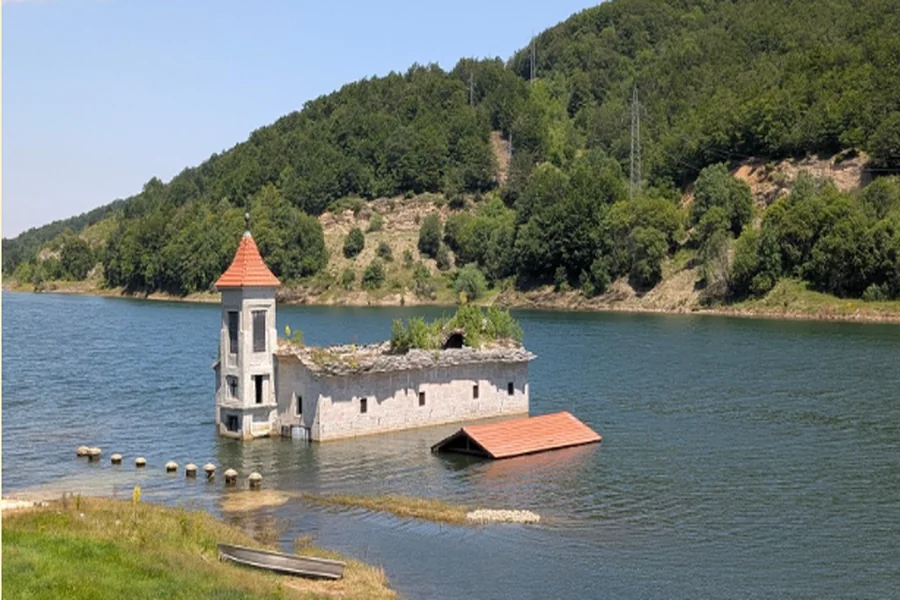
The reason to base yourself here is Mavrovo, the largest national park in North Macedonia and a short drive from town. Its centrepiece is Mavrovo Lake, an artificial reservoir ringed by forested slopes, and its most photographed sight is the church of St Nicholas, built in 1850 with icons by the painter Dicho Zograf. When the lake was created for a hydroelectric station, the church was left half-drowned, and today it stands with its stonework rising straight out of the water, a strange and beautiful accident of engineering.
The park is more than one photograph, though. It shelters the Bistra massif, deep beech forest and some of Europe’s last Balkan lynx, and in winter the Zare Lazarevski ski centre draws snow-seekers to its slopes.
Into the Šar Mountains and Up to Korab
South and west of the valley rises the Šar range, a wall of high, grassy summits that feels far bigger than the country around it. The ski resort of Popova Šapka, whose name translates as “the priest’s hat,” sits above 1,780 metres and offers both winter runs and summer hiking straight off the ridgelines.
Serious walkers aim higher still. Mount Korab, at 2,764 metres on the border with Albania, is the highest point of both countries at once, one of only two summits in Europe to hold that distinction alongside Mont Blanc. Reaching it takes planning and often a guide, but even a day among the lower Šar trails delivers wildflower meadows and views over three nations.
Day Trips: Tetovo, Ohrid and Beyond
With a car, the region opens up. Tetovo, half an hour north, is home to the Painted Mosque, a 15th-century building covered inside and out in vivid floral frescoes unlike anything else in the Balkans. Push further and you can reach Ohrid, the country’s lakeside jewel, in around two hours, its old town and ancient churches making a natural overnight if you have the time.
Closer to hand, the villages of the Polog plain reward slow driving, with roadside stalls selling honey, cheese and the season’s fruit.
Food and When to Go
Macedonian cooking is hearty and cheap. Look for tavče gravče, a baked bean dish served in a clay pot, ajvar, the smoky red pepper relish spread on everything, and grilled meats washed down with a glass of local Vranec red. Portions are large and the bill rarely stings.
As for timing, late spring through early autumn is best for the mountains, with warm days and open trails, while December to March turns Mavrovo and Popova Šapka into low-cost ski country. Come with a full tank and a loose plan, and Gostivar quietly becomes one of the most rewarding corners of the Balkans.