
Gold at Record Highs: What It Actually Means for Your Jewelry Box
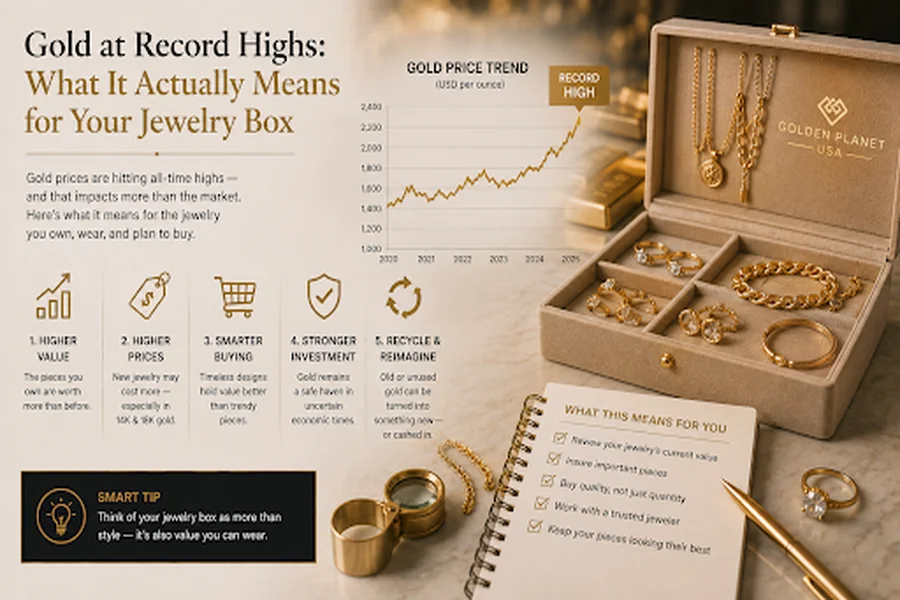
If you’ve bought anything gold in the last year or glanced at a jewelry store window, you’ve probably noticed the price tags don’t look the way they used to. That’s not your imagination, and it’s not a random price hike from one store. Gold itself has been on one of the wildest runs in its history, and it’s changing what’s in your jewelry box in ways most people haven’t fully connected yet. Golden Planet USA, a supplier of gold jewelry, has watched this shift play out from the production side, and the effects reach a lot further than most shoppers realize.
Why Everyone’s Suddenly Talking About Gold
Gold’s price nearly doubled over the past two years. It climbed steadily through 2024 and 2025, then broke into record territory in January 2026, touching an all time high of $5,589 an ounce. Since then it’s pulled back, settling into the $4,000s, still dramatically higher than where it started this whole run. For context, that kind of move is rare. Gold usually creeps. This time it sprinted, and the jewelry industry is still adjusting to what that sprint means for everyone from manufacturers to the person buying a birthday gift.
What This Means If You Already Own Gold Jewelry
Before thinking about anything new, it’s worth looking at what’s already sitting in your jewelry box, because the math has quietly changed underneath it.
Your Existing Pieces Are Worth More Than You Think
That chain you bought five years ago, the ring that’s been in a drawer since a relationship ended, the earrings you inherited. If they’re solid gold, they’re worth meaningfully more today than when you got them, purely because of what’s happened to the metal itself. This has nothing to do with the design, the brand, or how fashionable the style still is. It’s simply that the raw material inside the piece has climbed in price, and that increase belongs to whoever’s holding the jewelry.
How to Roughly Estimate What You’re Wearing
You don’t need a jeweler’s tools to get a rough sense of the value of gold jewelry sitting in your collection. The logic is simple: take the purity of the piece, which is usually stamped somewhere on it as 10K, 14K, 18K, or similar, multiply that by the weight, then multiply by the current price of gold. A 14K piece is about 58% pure gold, an 18K piece is 75%. You don’t need to be precise to get a useful ballpark. What matters is understanding that heavier, higher karat pieces have climbed the most in raw value, simply because they contain more of the metal that’s been moving. If you want to get more precise, the same idea scales up into how to calculate gold price for jewelry professionally, using exact gram weight and the live spot price rather than a rough guess.
What This Means If You’re Buying Now
The flip side of all this is what it means for anyone shopping for something new, whether it’s a gift or a piece for themselves.
Why the Same Ring Costs More Than Last Year
If you’ve reordered or repurchased something you bought a year or two ago and been surprised by the new price, this is why. The gold inside that ring costs more to buy today than it did back then, and that cost gets passed along the entire chain, from the workshop that made it to the counter where you’re standing. It’s not that jewelers are padding their margins. The raw material underneath the design simply costs more than it used to.
Lighter Pieces vs. Heavier Statement Pieces
One quieter shift worth knowing about: as gold has gotten more expensive, a lot of shoppers have started leaning toward lighter, more delicate pieces instead of the heavy statement styles that were popular a few years back. It’s a practical response more than a style change. A thinner chain or a smaller stud simply costs less to produce than a chunky version of the same idea, which keeps prices more approachable without giving up on solid gold entirely.
Does This Make Gold Jewelry a Smart Buy Right Now?
This isn’t investment advice, and gold jewelry isn’t the same thing as buying bullion or coins. But there’s a reason people talk about solid gold jewelry differently than most other purchases. Unlike a lot of things you buy, the gold inside a piece carries real, tradeable value tied to the market, not just to a brand name or a trend. That’s part of why so many people are asking is gold jewelry a good investment right now, more than they used to. It’s less about chasing a return and more about the fact that, unlike fast fashion or a trendy accessory, solid gold rarely goes to zero. Whether that makes any specific purchase a smart one for you depends on your own budget and what you actually want out of the piece, but the underlying logic is worth understanding either way.
Where Your Jewelry Actually Comes From (And Why It Matters for Price)
One thing a lot of shoppers never think about is how many hands a piece of jewelry passes through before it reaches a store shelf, and how each one adds a bit of cost on top of an already pricier metal. Buying from a source closer to the actual production, rather than a chain of resellers, tends to mean less of that markup gets tacked on before the piece reaches the counter. It’s part of why understanding where jewelry is actually made, and how directly it gets to the retailer selling it, has become a more relevant question for shoppers than it used to be.
Final Thoughts
Gold’s run over the last two years has reshaped more of the jewelry world than most people notice day to day, from what’s already in your jewelry box to what a new piece costs at the counter. None of it requires a finance background to understand. It mostly comes down to remembering that the metal itself has real, moving value, and that value belongs to whoever’s wearing it.